Before the Super Sport, There Was the Motorcycle That Changed Everything

The story of our 1977 CB750F really starts eight years earlier.
In 1969, the world's big-motorcycle establishment still belonged largely to Europe.
Triumph.
BSA.
Norton.
BMW.
Honda was already an enormous motorcycle manufacturer, but that reputation had been built mostly on smaller machines.
The big road bike was still someone else's territory.
Honda decided to change that.
The brief coming back from America was ambitious.
A 750cc motorcycle.
Four cylinders.
Four carburettors.
Four exhaust pipes.
Around 200 kilometres per hour.
Something big enough and powerful enough to appeal to American riders who had made one thing fairly clear to Honda:
Bigger was better.
Honda even learned that Triumph was developing a new 750cc three-cylinder motorcycle.
That helped settle the question.
Honda would build a 750 too.
But it wouldn't have three cylinders.
It would have four.
The result was the CB750 FOUR.
A 736cc, single-overhead-cam inline four.
Five-speed gearbox.
Electric starter.
Four carburettors.
Four exhaust pipes.
And, remarkably for a mass-production motorcycle in 1969, a hydraulic front disc brake.
Honda wasn't simply trying to build another big motorcycle.
It wanted to build what its engineers described as the world's best motorcycle.
Then came the part even Honda hadn't expected.
They initially forecast production of just 1,500 bikes for the entire year.
Orders arrived so quickly that 1,500 became the monthly target.
That still wasn't enough.
Production climbed to 3,000 bikes a month.
Inside the factory, an assembly line initially producing only a handful of CB750s each day eventually had to exceed 100.
Honda even had to abandon the early sand-cast crankcases and move to die-casting because the original manufacturing process simply couldn't keep up.
The world wanted the CB750 faster than Honda could build it.

Japan Changes the Rules
The CB750 wasn't Japan's biggest-selling motorcycle.
Not even close.
Honda's own Super Cub had already proven that Japan could build motorcycles by the millions.
But the CB750 proved something different.
Japan could build the motorcycle everybody else wanted to beat.
Until then, Britain's Triumphs, BSAs and Nortons were still among the machines that defined the serious large-capacity motorcycle.
Many were fast.
Some handled beautifully.
They had character, racing history and enormous prestige.
But underneath them were engineering ideas that had evolved gradually over decades.
Pushrod engines.
Separate gearboxes on earlier designs.
Vertically split crankcases.
Drum brakes.
Kick starters.
And the familiar quirks that riders had simply accepted as part of owning a big motorcycle.
Then the Honda arrived.
Press a button.
The four-cylinder engine starts.
It is smooth.
It doesn't shake itself apart.
There is a disc brake at the front.
It is fast enough to approach 200 kilometres per hour.
And Honda can manufacture thousands of them with remarkable consistency.
The CB750 didn't single-handedly destroy the British motorcycle industry.
Britain's manufacturers already had plenty of problems of their own.
But Honda exposed those problems brutally.
Suddenly, tradition wasn't enough.
The benchmark had moved.
And it had moved to Japan.
The CB750's importance wasn't simply that it sold well.
It changed what riders expected a large motorcycle to be.
Four cylinders.
Reliable.
Fast.
Easy to start.
Able to commute during the week, tour at the weekend and win major endurance races when properly prepared.
Soon, Kawasaki, Suzuki and Yamaha would answer.
The Japanese superbike era had begun.
And almost every big Japanese four that followed owes something to the motorcycle Honda put on the road in 1969.
Which brings us to ours.
Because by 1977, the motorcycle that had changed everything was facing a new problem.
Everyone else had caught up.
1977 Honda CB750F Super Sport: The Final Form of the Original Superbike
By 1977, Honda had a very different problem from the one it faced in 1969.
The original CB750 had changed the rules.
Now everybody else was playing by them.
Kawasaki had arrived with the Z1.
Suzuki had the GS750.
Large Japanese four-cylinder motorcycles were no longer unusual.
Honda had created the formula, but it no longer owned it.
Even inside Honda there was a growing awareness that the company could not simply keep polishing the same ideas forever.
Honda later acknowledged that although the CB750 had been followed by a string of successful motorcycles through the 1970s, much of its core motorcycle technology still had roots in the engineering thinking of the 1960s.
There was a feeling inside the company that if that continued, Honda's once world-leading motorcycle technology could be left behind.
That makes the 1977 CB750F2 particularly interesting.
It arrived right near the end of the original single-overhead-cam CB750 era.
Honda wasn't ready to throw the old engine away yet.
So instead, it went back into it.
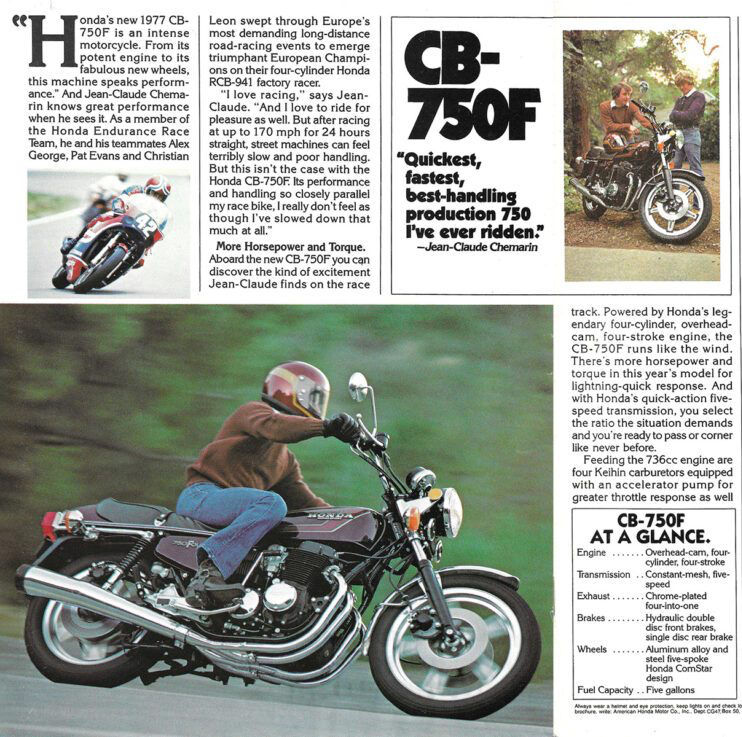
Getting More From the Old Four
The 1977 F2 looked similar to the Super Sport that came before it.
Inside, however, Honda had been busy.
The engine received larger valves.
More aggressive camshafts.
Revised cylinder-head work.
A higher operating ceiling.
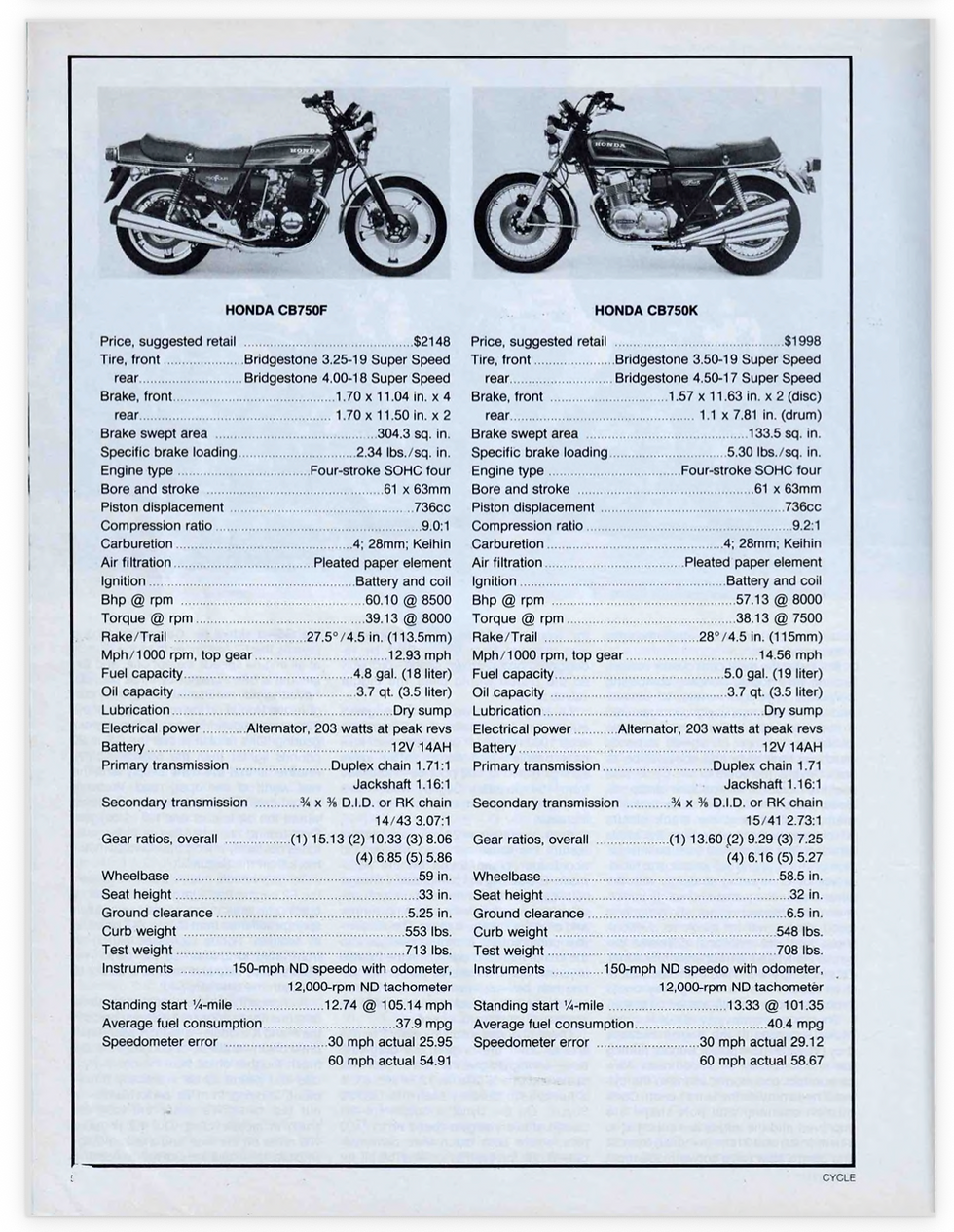
The redline moved all the way to 9,500 rpm, which was serious territory for a 750cc road motorcycle in 1977.
The gearing was shortened slightly to give the bike more punch.
Honda also used 28mm Keihin carburettors with accelerator pumps.
The result wasn't a completely new engine.
It was something almost more interesting.
Honda engineers were finding out just how much more they could extract from the architecture that had started the superbike revolution eight years earlier.
When Cycle World tested the F2 in 1977, its writers called it the best CB750 Honda had produced.
What impressed them most wasn't simply the performance.
It was how civilised Honda had managed to make it.
They described the motor as remarkably mild-mannered for something capable of revving that high.
That says a lot about Honda.
More power was only part of the job.
It still had to start easily.
Idle properly.
Pull cleanly from low revs.
Carry a passenger.
Survive normal road use.
Honda wasn't building a fragile race engine with lights.
It was trying to make a faster road motorcycle without losing the qualities that had made the CB750 successful in the first place.
Racing Was Starting to Find Its Way Back In
There was another influence creeping back into Honda during this period.
Racing.
Honda had withdrawn from Grand Prix motorcycle racing at the end of the 1960s, but many of the people inside Honda Research and Development had come from racing.
They hadn't forgotten it.
During the mid-1970s Honda began developing endurance racers based around the CB750 engine.
The most famous were the RCB machines.
They became extraordinarily successful in European endurance racing.
That racing programme started feeding ideas back into Honda's road motorcycles.
You can see one of them immediately on the 1977 F2.
The wheels.

Honda Didn't Trust Ordinary Cast Wheels
The ComStar wheels are one of those parts of the CB750F that look completely normal now because we already know what came afterwards.
But in 1977 they were unusual.
Motorcycles had traditionally used wire-spoked wheels.
Cast alloy wheels were beginning to appear, particularly in racing, but Honda's engineers had concerns.
Large, thin metal castings can cool unevenly during production.
Honda worried that flaws or weak points could remain hidden inside the wheel.
At the same time, Honda understood the shortcomings of traditional spokes.
They flexed.
They needed adjustment.
They needed truing.
Honda's engineers wanted the rigidity and maintenance advantages of a cast wheel without completely trusting the casting process.
So they created their own answer.
ComStar.
An aluminium hub.
Pressed metal spokes.
A separate rim.
All mechanically joined together.
Honda had already been testing them on endurance racing machines before they appeared on road bikes.
And Honda being Honda, they didn't simply bolt them together and hope.
Contemporary visitors to Honda R&D described elaborate wheel-testing machinery designed to twist, bend and repeatedly load the wheels while engineers searched for fatigue or failure.
This is one of the things I find fascinating about the CB750F.
Some of its most distinctive styling features weren't styling exercises at all.
They came out of engineers trying to solve problems.
Three Disc Brakes
Then look at the brakes.
The original CB750 had caused a sensation in 1969 by fitting a hydraulic front disc when most production motorcycles still relied on drums.
Eight years later, the F2 had gone much further.
Twin discs at the front.
Another disc at the rear.
Three discs on one motorcycle.
Again, it doesn't sound exotic now.
At the time, it told you where Honda believed performance motorcycles were heading.
More speed meant more braking.
The superbike was evolving into a complete package.
Engine.
Chassis.
Wheels.
Brakes.
Honda was no longer relying on the fact that it had four cylinders.
Everyone had learned that trick.
The Four-Into-One
Then there is the exhaust.
The four individual pipes on the original CB750 are arguably one of the most recognisable motorcycle designs ever made.
Four cylinders.
Four pipes.
Honda wanted everybody looking at the bike to know exactly what was inside the engine.
By the time the Super Sport arrived, the message had changed.
The F used a four-into-one system.
Four header pipes sweeping down from the cylinder head and meeting underneath the engine before exiting through a single muffler.
It immediately made the bike look leaner.
More purposeful.
More like the endurance racers appearing on racetracks.
It also became one of the first things owners changed.
That was already happening when these bikes were new.
Period riders fitted aftermarket four-into-one systems, changed carburettor jetting and started looking for more power.
Which makes the modifications on our bike feel oddly appropriate.
Today it runs Keihin CR29 carburettors and a MotoGPwerks four-into-one exhaust.
They aren't factory pieces.
But the thinking behind them is hardly new.
People have been hot-rodding CB750s almost from the moment Honda started selling them.
The Shape Was Changing Too
The 1977 Super Sport also looks very different from the motorcycle Honda launched in 1969.
The original CB750 is handsome in that classic Japanese-road-bike way.
Chrome.
Spoked wheels.
Four individual exhausts.
A relatively upright stance.
The F2 has started moving somewhere else.
The tank looks longer.
The body sits lower.
The tail section feels more integrated.
The black engine treatment makes the motor look harder.
The ComStar wheels pull it visually into the late 1970s.
And the four-into-one exhaust stretches underneath the bike like a line drawn from the cylinder head to the rear wheel.
You can see the sports bike beginning to take shape.
Not yet a GSX-R.
Not even close.
But the motorcycle is starting to become less of a universal road machine and more obviously built around performance.
That transition is a big part of why this version of the CB750 appeals to me.
It still has the proportions and mechanical honesty of a 1970s motorcycle.
But it has started leaning toward what came next.
Honda Was Already Thinking About What Came Next
The F2 was good.
But Honda knew the original CB750 architecture was reaching the end of the road.
And the company was beginning to look back toward racing for the next leap.
Honda would soon develop an entirely new generation of CB750 and CB900F machines using double-overhead-cam, four-valve cylinder heads and technology influenced heavily by endurance competition.
For those later bikes, Honda designers even went into the European market to study what sports-bike riders actually wanted.
They began thinking about the fuel tank, side covers and tail not as separate pieces, but as one continuous shape.
Honda called the result its "Flowing Line" design philosophy.
The modern sports motorcycle was starting to become something designed as a complete visual object.
That would come next.
Our 1977 F2 sits just before it.
That is part of what makes it special.
It is one of the last serious developments of the motorcycle Honda started with in 1969.
The original SOHC engine.
The original basic architecture.
But pushed about as far as Honda was prepared to take it.
A Motorcycle You Can Read
There is another reason I like this generation.
You can look at it and understand it.
The engine is sitting there in the open.
Four cylinders across the frame.
Carburettors hanging behind them.
Four header pipes leaving the front.
Oil lines.
Cooling fins.
Chain.
Disc brakes.
Nothing important is particularly interested in hiding.
And when something isn't right, the bike starts talking to you.
One cylinder isn't firing properly.
One exhaust header stays cooler than the others.
The engine will only stay alive with choke.
One carburettor needs adjustment.
You start working backwards.
Fuel.
Air.
Spark.
Compression.
That has been part of our experience with this bike already.
It hasn't simply arrived in the garage as a polished display piece.
We've been trying to understand it.
Balancing the CR29 carburettors.
Setting air screws.
Chasing a weak cylinder.
Reading exhaust temperatures.
Pulling plugs.
Listening.
Adjusting.
Trying again.
There are moments when modern fuel injection suddenly seems like a wonderful invention.
But there is also something satisfying about eventually understanding why an old engine is behaving the way it is.
The machine teaches you.
Sometimes patiently.
Sometimes not.
Why This One Is in the Garage
The CB750F earns its place here for two reasons.
The first is history.
The CB750 changed what the world expected from a large motorcycle.
It helped establish the inline-four Japanese superbike formula.
It changed manufacturing expectations.
It forced competitors to respond.
And by 1977, the F2 represented Honda extracting one last serious round of performance from that original idea.
But the second reason is simpler.
It looks right.
Long tank.
Rear Cowel.
The term "Super Sport".
Four pipes dropping out of the front of an air-cooled four.
That unmistakable late-70s shape.
It sits in a really interesting place.
Old enough to still feel like a classic motorcycle.
Modern enough that you can see the superbike coming.
And there is another reason I like having it here.
Park the 1977 Honda beside the 1987 Suzuki GSX-R1100 and you can see ten years of motorcycle development sitting on the floor in front of you.
The Honda has a steel tube frame.
The Suzuki has aluminium.
The Honda engine is air-cooled.
The Suzuki uses its elaborate oil-cooling system.
The Honda is almost completely naked.
The Suzuki is wrapped in endurance-racing bodywork.
The Honda still belongs partly to the traditional road-bike world.
The Suzuki has become a full-blown race replica.
Only ten years separate them.
That might be one of the best things about collecting motorcycles from different periods.
You don't just read about how motorcycles evolved.
You can park the evolution beside itself.
The End of the First Chapter
The 1969 CB750 gets most of the attention.
Fair enough.
It was the motorcycle that caused the shock.
But the 1977 CB750F2 tells a different part of the story.
It shows what happens after the revolution.
Competitors respond.
Technology moves.
Riders demand more.
And eventually even the motorcycle that changed everything has to change itself.
Honda took the original CB750 formula and kept working at it.
More power.
More revs.
More braking.
Race-developed wheels.
Sportier bodywork.
A harder edge.
Then, when there was little more to take from it, Honda turned the page.
That's why I like the 1977 Super Sport.
It isn't the beginning of the CB750 story.
It's the final version of the idea before everything changed again.
And there is something worth preserving about that.
The last evolution of the original superbike.
Still mechanical.
Still understandable.
Still sitting there waiting for us to get those four carburettors just right.



Comments